If you've been dealing with a sore, clicking, or locked-up jaw, you've probably already been told it's "just TMJ." That label gets used a lot, but it rarely explains what's actually happening or what to do about it. Patients from Denton and Cross Roads come to us for this exact issue, and here's what we tell them: most jaw pain isn't a problem with the joint itself. It's a problem with the muscles surrounding it. And that distinction matters, because it changes how we treat it.
What's Actually Going On With TMJ Dysfunction
The temporomandibular joint (TMJ) is the hinge connecting your jaw to your skull, just in front of your ears. It's one of the most-used joints in your body. You move it every time you talk, chew, yawn, or swallow. Surrounding that joint is a group of muscles (the masseter, temporalis, and pterygoids) that control all of that movement.
When those muscles get overworked (from clenching your teeth at night, grinding, stress, poor posture, or an old jaw injury) they develop trigger points: small, tight knots of muscle fiber that stay contracted even when you're not actively using them. Those trigger points don't just sit quietly. They refer pain to other areas, which is why TMJ dysfunction so often shows up as more than just jaw soreness. Patients come in describing:
- A dull ache in front of the ear that gets worse with chewing
- Clicking or popping when opening and closing the mouth
- Tension headaches that start at the temples or behind the eyes
- Neck and upper shoulder tightness
- A jaw that feels like it's "stuck" or doesn't open all the way in the morning
Because the pain often radiates to the head and neck, a lot of people spend months treating headaches or neck tightness without anyone ever checking the muscles actually driving the problem.
Why Stretching and Heat Alone Don't Fix It
Most standard advice for TMJ issues (warm compresses, jaw stretches, avoiding hard foods) can take the edge off, but it doesn't resolve a trigger point. A trigger point is a localized dysfunction in the muscle fiber itself; it's not something you can stretch your way out of any more than you can stretch out a knot in a rope. You need something that gets directly into that tissue and interrupts the contraction.
How Dry Needling Targets It
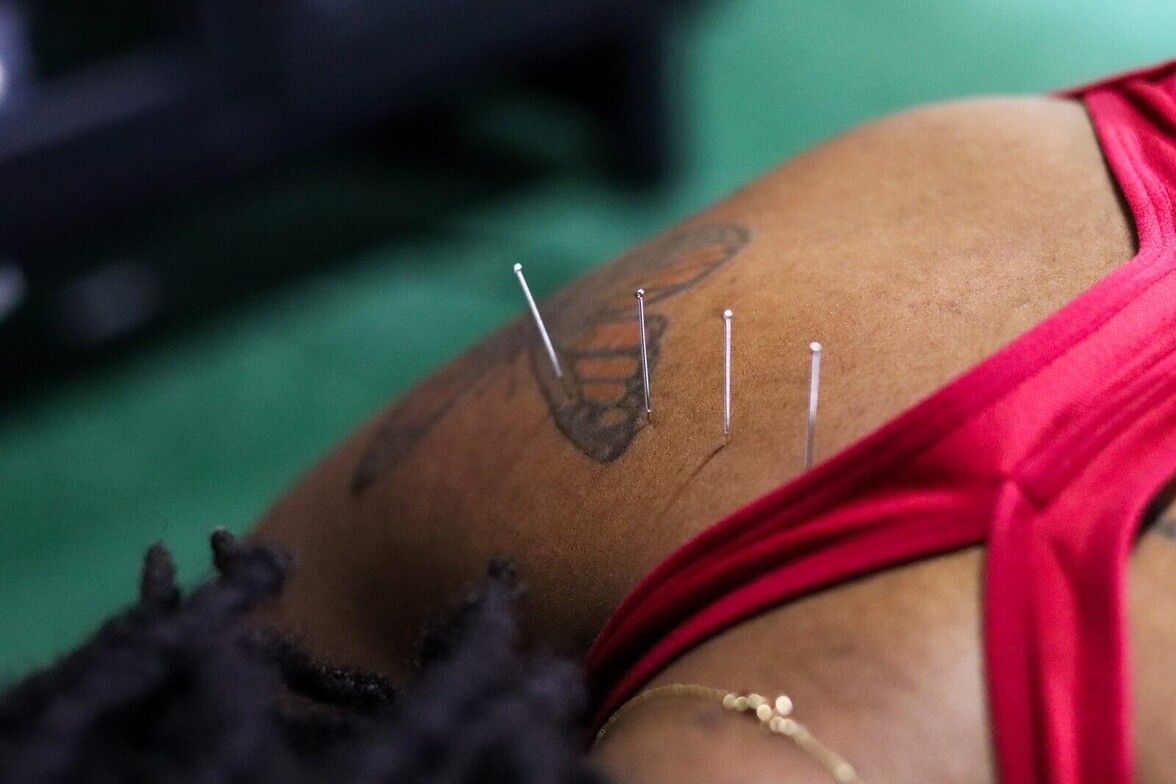
Dry needling uses a thin, solid filament needle inserted directly into the trigger point. Unlike a stretch or massage, which works on the surface, the needle reaches the muscle fiber itself and triggers a local twitch response: an involuntary contraction that releases the knot and restores normal blood flow to the area. For jaw and facial muscles, this means working carefully and precisely in a small, sensitive area: the masseter along the cheek and jawline, and the temporalis at the temple, are the two muscles we treat most often for TMJ-related pain.
Many patients notice they can open their mouth further right away, and some notice less referred headache pain within a day or two. Because the jaw muscles respond well to direct, targeted work, dry needling is a strong option to try before more invasive routes, since it addresses the muscle component that often gets overlooked.
Who This Helps
TMJ dysfunction isn't limited to athletes, but we see it constantly in patients who grind their teeth under stress, clench during workouts, or have had a prior jaw or facial injury from contact sports. If you're waking up with a sore jaw, dealing with headaches that don't respond to the usual remedies, or noticing your jaw clicks or catches when you eat, it's worth having the muscles evaluated before assuming it's purely a joint or dental issue.
Getting Evaluated
At Limitless Sports Chiropractic, we treat TMJ dysfunction as a hands-on musculoskeletal issue, not just a dental one. A thorough evaluation looks at how your jaw moves, which muscles are involved, and whether the problem is connected to posture or tension patterns higher up in the neck and upper back, a combination we see often in patients from Cross Roads, Denton, and the surrounding area.
If jaw pain, clicking, or tension headaches have been dragging on longer than they should, don't wait for it to resolve on its own. Give our office a call or book online to get an evaluation and find out whether dry needling can help you break that cycle.

Taylor Hartman
Contact Me