You rolled your ankle months ago. The swelling went down weeks ago. But it still doesn't feel right: a little loose, a little unstable, like it might give out again if you cut hard or land wrong off a jump. If that sounds familiar, you're not imagining it, and you're not alone. Ankle sprains are one of the most common injuries we see at our Oak Point clinic, and chronic ankle instability after a “healed” sprain is even more common than most athletes realize.
Why an Ankle Sprain Doesn't Just “Heal and Move On”
A typical ankle sprain stretches or tears the ligaments on the outside of the ankle, usually the anterior talofibular ligament (ATFL). Most people rest it, ice it, maybe wear a brace for a week or two, and once the pain and swelling fade, they assume it's fixed. But healing ligament tissue doesn't always lay down in the same clean, organized pattern as the original tissue. Instead, your body often repairs the area with disorganized scar tissue and adhesions between the ligament, tendon sheaths, and surrounding fascia.
That scar tissue is stiffer and less elastic than healthy ligament. It can also disrupt the proprioceptive nerve endings in and around the joint: the sensors that tell your brain where your ankle is in space and help it react instantly to an uneven step or a sudden change of direction. That's why so many athletes describe a “healed” ankle that still feels unstable, gives out unexpectedly, or seems to roll more easily than it used to. You're not dealing with a fresh injury. You're dealing with old tissue that never fully remodeled.
How Graston Technique Addresses the Real Problem
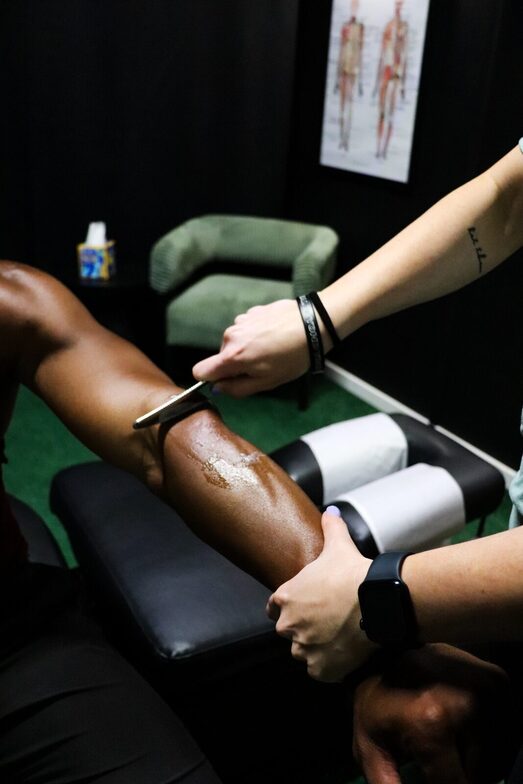
Graston Technique is a form of instrument-assisted soft tissue mobilization (IASTM). We use specially designed stainless steel instruments to systematically scan and treat the ligaments, tendons, and fascia around the ankle. The edges of the instrument allow us to detect areas of restriction, scar tissue, and fibrotic buildup that are difficult to feel with hands alone, and then apply targeted pressure to break up those adhesions.
This does a few important things for a chronically unstable ankle. It breaks up the disorganized scar tissue and adhesions binding the ligament fibers together, restoring more normal sliding and gliding between tissue layers. It stimulates a localized, controlled inflammatory response, which signals the body to lay down new collagen in a more organized, functional pattern along the lines of stress the ankle actually experiences during running, cutting, and jumping. And it helps restore the proprioceptive feedback from the joint, which is a major piece of why instability lingers even after pain resolves: the ligament may be structurally fine, but the nerve signaling around it is still disrupted.
We almost always pair Graston work on a chronically sprained ankle with joint mobilization to restore normal ankle and subtalar joint motion, plus a progressive balance and proprioception program (single-leg stance drills, wobble board work, and sport-specific cutting and landing mechanics). Treating the tissue without retraining the joint's sense of position leaves half the problem unaddressed, which is a big reason so many “just wear an ankle brace” approaches never fully resolve the instability.
Signs You're Dealing With This, Not Just Normal Soreness
If it's been more than six to eight weeks since your last ankle sprain and you're still noticing any of the following, chronic instability from residual scar tissue is a likely culprit: a feeling of looseness or “give” when you plant and cut, repeated minor re-rolling of the same ankle, a persistent ache along the outside of the ankle after activity, or noticeably worse balance on that side compared to the other leg. These aren't things you have to just manage forever with tape and a brace. They're treatable.
Getting Back to Full Confidence on That Ankle
We see this constantly in athletes across Oak Point, Little Elm, Prosper, and Aubrey: soccer players, basketball players, runners, and weekend warriors who rolled an ankle back in the spring and have just been playing around the instability ever since because the initial pain went away. The tissue restriction and the proprioceptive deficit don't resolve on their own just because the swelling did.
If you've got an ankle that's never quite felt the same since a sprain, don't wait for it to become the injury that sidelines you again. At Limitless Sports Chiropractic, we'll assess the joint, the ligament tissue, and your balance and movement mechanics, then build a treatment plan combining Graston Technique, joint mobilization, and targeted rehab to rebuild that ankle's strength and stability. Reach out today to schedule an evaluation and stop letting an old sprain limit what you can do on the field or court.

Taylor Hartman
Contact Me