If you run, cycle, or play a sport that has you logging miles week after week, you've probably felt it: a sharp, burning ache on the outside of your knee that shows up a mile or two into a run and doesn't let up until you stop. Most people call it IT band syndrome, and most people try to fix it the same way: foam rolling the outside of the thigh until it's black and blue, stretching, maybe taping it before a race. And for a lot of runners here in Oak Point, that approach works for a week or two, then the pain comes right back.
Here's why: the iliotibial band isn't a muscle. It's a long, dense strip of connective tissue that runs from your hip down to just below your knee, and it doesn't stretch or "release" the way a tight muscle does. When it's inflamed and thickened at the point where it rubs across the femur near the knee, rolling it with a hard foam cylinder is often just aggravating already-irritated tissue rather than actually changing it. That's why so many athletes tell us they've foam rolled for months with no real change.
What's Actually Happening With IT Band Syndrome
IT band syndrome is almost always an overuse and biomechanics problem before it's a "tight IT band" problem. Weakness in the hip abductors and glutes lets the femur rotate inward with every stride, which increases friction where the band crosses the outside of the knee. Add in a sudden increase in mileage, worn-out shoes, or always running the same direction on a cambered road, and that friction turns into real inflammation. By the time it hurts during a run, the tissue along the band and around the lateral knee has usually developed adhesions and restricted mobility that a stretch alone can't undo.
Why Graston Technique Works Differently
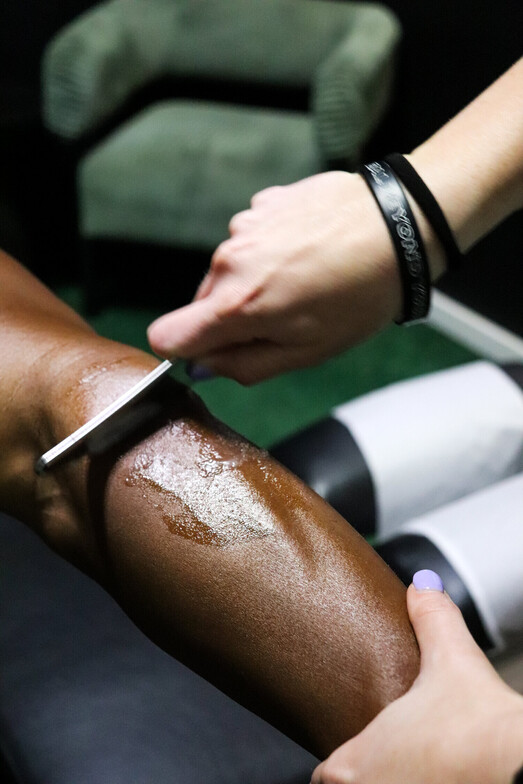
This is where Graston Technique, a form of instrument-assisted soft tissue mobilization, changes the picture. Instead of a rounded foam roller putting broad, generalized pressure across the whole thigh, we use stainless steel instruments with specific edges and contours to find and treat the exact areas of restriction along the IT band, the lateral quad, and the tissue around the hip. The instruments let us detect adhesions and areas of fibrosis that we simply can't feel as precisely with hands alone, and they let us apply a controlled, targeted force directly to that tissue.
That targeted micro-trauma triggers a real physiological response: it increases local blood flow, breaks up restrictive adhesions between tissue layers, and kicks off your body's natural healing and remodeling process. Over a series of visits, the tissue along the band becomes more mobile and glides properly again instead of catching and rubbing with every stride. Most patients feel some soreness for a day or so after treatment, similar to a hard workout, and that's a normal part of the tissue responding.
It's Rarely Just the IT Band
When someone comes into our Oak Point clinic with lateral knee pain, we don't just treat the six inches of tissue that hurts. We look at hip and glute strength, ankle and foot mechanics, and how you're actually running or moving, because if the underlying weakness or movement pattern that overloaded the IT band in the first place doesn't get addressed, the pain has a way of coming right back after a few good weeks. That's why we usually pair Graston work with chiropractic adjustments to restore proper joint mechanics at the hip, knee, and low back, along with a specific strengthening plan for the glutes and hip stabilizers.
Who This Helps
This isn't just a runner's issue. We see it in cyclists, soccer and basketball players, and weekend warriors across Oak Point, Little Elm, Prosper, and Aubrey who ramped up activity too quickly or never addressed a hip weakness that's been there for years. If you've got that familiar outer-knee ache that flares up at a predictable distance or time into activity, and it hasn't responded to rest, stretching, or rolling it out on your own, it's worth getting it looked at rather than hoping it resolves on its own. Left alone, IT band syndrome often lingers and can sideline you from training.
At Limitless Sports Chiropractic, soft tissue therapy like Graston Technique is one of the tools we use most often for exactly this kind of overuse injury, because it addresses the tissue restriction directly instead of just masking the pain. If outer knee pain has been holding back your training, book a visit and let's figure out what's actually driving it and get you back to running.

Taylor Hartman
Contact Me