If you've got a pinch or a deep ache in your shoulder every time you reach overhead, behind your back, or throw a ball, you've probably been told to "just rest it" or "strengthen the rotator cuff." Sometimes that works. Often it doesn't — because the tissue causing the problem never gets addressed directly.
That's shoulder impingement, and it's one of the most common complaints I see from athletes and active adults here at Limitless Sports Chiropractic.
What's Actually Happening in Your Shoulder
Shoulder impingement happens when the tendons of your rotator cuff — usually the supraspinatus — get compressed as they pass through a narrow space under the acromion (the bony ridge on top of your shoulder blade) every time you lift your arm. That compression, repeated over thousands of reps of throwing, lifting, swimming, or just reaching into a cabinet, leads to irritation, inflammation, and eventually thickened, fibrotic scar tissue in the tendon and surrounding structures.
Once that scar tissue builds up, it changes how the tendon glides. Instead of moving smoothly through that narrow subacromial space, it catches. That's the pinch you feel at the top of a reach, or the ache that flares up after a workout and lingers for days.
Rest reduces the inflammation temporarily, but it doesn't remodel the tissue. Neither does strengthening alone — if anything, loading a tendon that's already restricted by adhesions and poor tissue quality can aggravate it further before it improves. This is exactly why so many people cycle through months of shoulder pain that gets a little better, then flares right back up.
Where Graston Technique Comes In
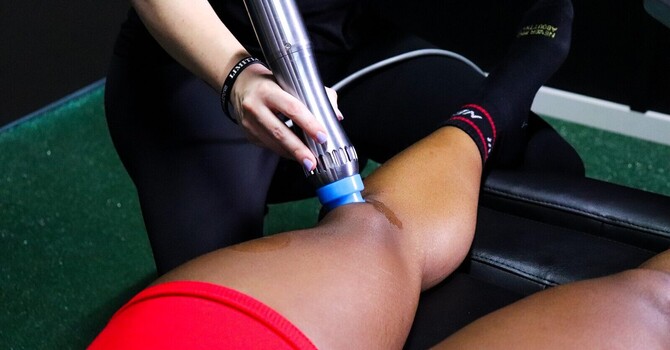
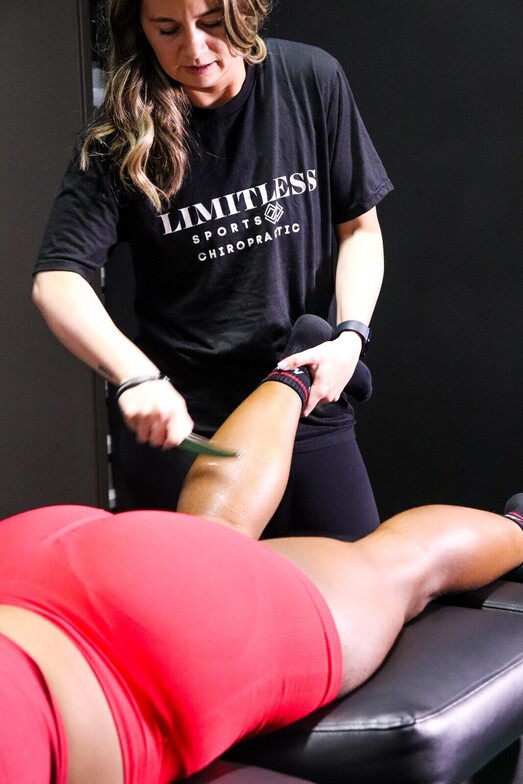
Graston Technique uses stainless steel instruments to apply controlled, precise pressure across the soft tissue of the shoulder — the rotator cuff tendons, the subacromial bursa region, and the surrounding fascia. The instruments let me feel and treat adhesions and restrictions that are difficult to isolate with hands alone.
What the instrument is actually doing is twofold. First, it breaks up disorganized scar tissue and fascial adhesions that have built up around the tendon, restoring the smooth gliding motion the joint needs. Second, it creates a controlled micro-trauma that triggers your body's natural healing response — increasing local blood flow and stimulating fibroblasts to lay down new, better-organized collagen in place of the old, restrictive tissue.
Patients typically describe the sensation as an intense, deep pressure — not painful in the sharp sense, but noticeably different from a massage. Most people see a change in overhead range of motion within the first two to three sessions, though full resolution of chronic impingement usually takes four to six weeks of consistent treatment paired with a targeted strengthening progression once the tissue quality improves.
Why Pairing It With the Right Exercise Matters
Graston Technique addresses the tissue restriction. It doesn't fix scapular mechanics or rotator cuff weakness on its own. That's why I don't treat shoulder impingement with Graston in isolation — once the tendon is gliding properly and the pain has come down, we layer in scapular stabilization and rotator cuff strengthening work so the shoulder doesn't just feel better, it actually moves better under load. Skip that step and the impingement tends to come back, because the underlying movement pattern that caused it in the first place is still there.
Who This Helps Most
This approach works well for swimmers, throwers, CrossFit and weightlifting athletes, tennis and volleyball players, and honestly anyone whose daily life or job involves repetitive overhead reaching — painters, warehouse workers, parents lifting toddlers in and out of car seats. If you've had shoulder pain for more than a few weeks that isn't responding to rest, it's worth getting the tissue itself evaluated rather than just waiting it out.
Ready to Get Your Shoulder Moving Again?
If overhead reaching, throwing, or lifting has become something you dread instead of something you do without thinking, we can help. As a sports chiropractor in Oak Point, TX, I work with athletes and active adults throughout Oak Point, Little Elm, Prosper, and Aubrey, TX to get to the root of soft tissue restrictions like shoulder impingement — not just manage the symptoms.
Ready to find out what's really limiting your shoulder? Book an appointment at Limitless Sports Chiropractic today and let's get you back to full, pain-free overhead motion.

Taylor Hartman
Contact Me