If the front of your knee has been swollen, warm, and tender to kneel on for weeks — even though nothing ever "gave out" or twisted wrong — you're probably not dealing with a ligament or meniscus injury. You're dealing with prepatellar bursitis, sometimes called "housemaid's knee" or "carpet-layer's knee," and it's one of the most misunderstood knee problems I see in the clinic.
What's Actually Going On
Right in front of your kneecap sits a small, fluid-filled sac called the prepatellar bursa. Its only job is to let skin and soft tissue glide smoothly over the bone every time you bend or kneel. Under normal conditions you never notice it's there. But repetitive kneeling, direct impact, or a sudden increase in training volume can irritate that sac, and it responds the way irritated tissue always does — by producing more fluid and swelling up.
That's why prepatellar bursitis shows up constantly in catchers, wrestlers, volleyball players, and anyone who kneels for a living or a hobby (flooring installers, gardeners, roofers). It also shows up in runners and cyclists who've ramped up mileage without giving the front of the knee time to adapt. The telltale sign is a soft, movable swelling right over the kneecap — distinct from the deep, joint-line pain of a meniscus tear or the instability of a ligament sprain. Kneeling is often unbearable; walking and running are frequently fine.
Here's the part that surprises most patients: prepatellar bursitis isn't really an inflammation problem anymore once it's been hanging around for more than a few weeks. Early on, yes, it's acute inflammation. But chronic bursitis is a thickened, fibrotic bursa wall — the tissue itself has changed. That's precisely why rest, ice, and anti-inflammatories often stall out. You can't stretch or ice your way through fibrotic tissue. You need something that stimulates the tissue to actually remodel.
Where Shockwave Therapy Comes In
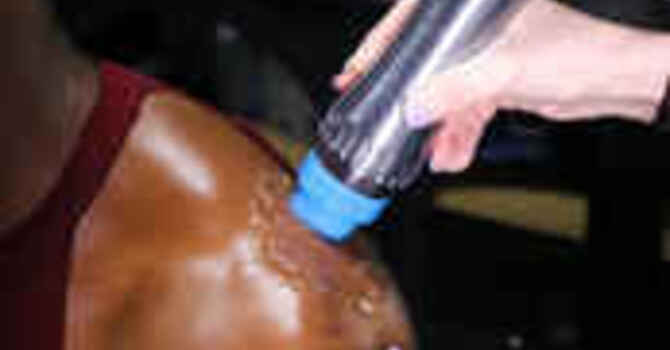
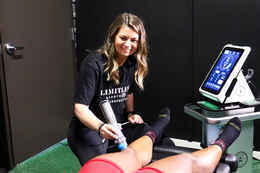
Extracorporeal shockwave therapy delivers focused acoustic pulses into the thickened bursa wall and the surrounding soft tissue. Those pulses do two things that matter for a stubborn bursitis: they trigger a localized micro-inflammatory response that restarts the body's healing cascade in tissue that has essentially stalled out, and they stimulate new blood vessel formation (neovascularization) in an area that typically has poor blood supply to begin with — which is a big part of why bursitis lingers instead of resolving on its own.
Shockwave also has a well-documented effect on pain signaling, which is why a lot of patients notice reduced tenderness within the first one or two sessions, well before the swelling itself has fully resolved. A typical course runs three to six weekly sessions, each lasting roughly ten minutes, and it's entirely non-invasive — no needles, no incisions, no downtime. Most patients are back to normal training and kneeling activities within a few weeks of finishing the course.
This is also why we don't jump straight to shockwave the moment someone walks in with a swollen knee. If a bursa is acutely inflamed or there's any concern about infection (septic bursitis is a real thing and needs different management entirely), shockwave is not the right first step. Part of a proper evaluation is ruling that out first, then confirming this is mechanical, chronic bursitis before treatment starts.
Why This Gets Missed So Often
A lot of patients spend months icing a swollen knee, assuming it'll "just go down eventually," or get told to avoid kneeling indefinitely. That approach treats the symptom without addressing why the bursa thickened in the first place — usually a combination of repetitive mechanical load and a bursa wall that never got the chance to properly remodel. Addressing the underlying tissue is what actually gets people back to kneeling, squatting, and training without the knee filling back up every time they push volume.
Getting Back to Kneeling Without Wincing
If you've got a knee that swells every time you kneel, garden, coach from the sideline, or spend a weekend on the floor with your kids, it's worth getting it properly evaluated rather than continuing to work around it. At Limitless Sports Chiropractic, we treat prepatellar and other forms of knee bursitis in athletes and active adults throughout Prosper and Crossroads, TX, along with our home base in Oak Point, using shockwave therapy alongside a full movement assessment to address why the irritation started in the first place.
If that swollen, achy kneecap has been sidelining you, reach out to schedule an evaluation at Limitless Sports Chiropractic. We'll figure out exactly what's going on and build a plan to get you back to kneeling, training, and moving without the constant flare-ups.
Taylor Hartman
Contact Me