If you've ever felt that tight, achy band across your mid-back after a heavy lifting session, a long run, or just a day hunched over a desk, you've probably chalked it up to "bad posture" and moved on. Most people do. But that stiffness between your shoulder blades — in the thoracic spine — is rarely just a posture problem, and it's one of the most overlooked issues I see in athletes who come through our doors here at Limitless Sports Chiropractic.
Why the Thoracic Spine Gets Ignored
Your spine has three regions: cervical (neck), thoracic (mid-back), and lumbar (low back). Most people are quick to seek care for neck pain or low back pain because those areas are more mobile and the pain is usually sharper and more obvious. The thoracic spine is different. It's built for stability, not mobility — it's anchored to your rib cage on both sides, which means it doesn't move as freely to begin with. When it loses even a little bit of its normal motion, you often don't feel a dramatic injury. You just feel "tight," and that tightness gets ignored until it starts affecting everything above and below it.
That's the real issue: a stiff thoracic spine doesn't stay contained to your mid-back. Your body compensates by pulling extra motion from your neck and low back, the two regions that were never designed to do that much work. This is why so many of the neck and low back complaints we treat actually trace back to restricted thoracic mobility that's been quietly building for months.
Who This Shows Up In
I see this constantly in:
- Lifters and CrossFit athletes who round through overhead positions because their thoracic spine won't extend properly
- Runners and cyclists who develop that forward-hunched posture from hours in a flexed position
- Golfers and baseball/softball players whose rotational power is capped because the mid-back won't rotate freely
- Desk workers and student-athletes who spend hours a day hunched over a laptop or a phone between practices
If you've noticed your overhead lifts feel capped, your golf or throwing rotation has lost some snap, or you just can't take a full deep breath without your mid-back feeling "stuck," restricted thoracic mobility is a likely culprit.
How We Assess and Treat It
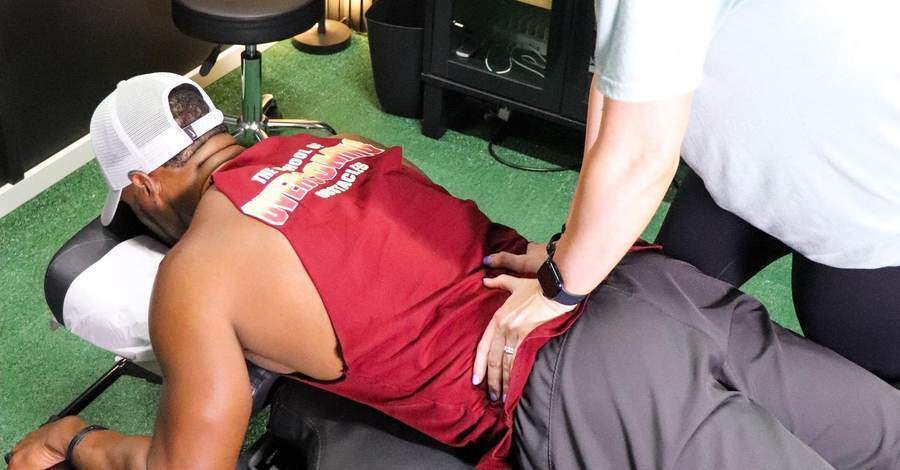
When a patient comes in with thoracic complaints, we don't just look at the mid-back in isolation. We assess how your thoracic spine moves in extension and rotation, how that's affecting your shoulder mechanics, and whether your neck or low back has started overcompensating. Chiropractic adjustments to the thoracic spine restore that segmental motion directly — you'll often feel an immediate difference in how freely you can rotate or extend afterward.
We frequently pair adjustments with soft tissue work along the surrounding musculature, since the muscles around a restricted joint tend to guard and tighten in response. Restoring the joint motion without addressing that guarding usually means the stiffness creeps back within a few days. Addressing both together is what makes the change stick.
This isn't a one-and-done fix for most athletes. Thoracic mobility work is often part of an ongoing care plan, especially if your sport or your job keeps putting you back into the same flexed, rounded positions day after day. The goal isn't just to relieve the tightness you're feeling right now — it's to keep your spine moving the way it's supposed to so your neck and low back don't have to keep picking up the slack.
When to Get It Checked
You don't need a dramatic injury to justify getting your thoracic spine evaluated. If you've got a nagging band of tightness between your shoulder blades that doesn't resolve with foam rolling or stretching, if your overhead or rotational movements feel limited, or if you've already been treated for neck or low back pain without full relief, it's worth having someone actually assess your mid-back mobility rather than just guessing.
At Limitless Sports Chiropractic, we work with athletes and active adults throughout Oak Point, Little Elm, Prosper, and Aubrey, TX who want to move and perform without compensating around a stiff spine. As a sports chiropractor Oak Point TX athletes trust for this kind of evaluation, I'll walk you through exactly what's restricted, why, and what it's going to take to get it moving properly again.
If that tightness between your shoulder blades has been part of your routine for longer than you'd like to admit, let's take a look at it. Book an appointment at Limitless Sports Chiropractic and let's get your whole spine — not just the loudest part of it — moving the way it should.

Taylor Hartman
Contact Me