A groin pull feels minor at first. You feel a sharp grab on the inside of your thigh during a cut, a sprint, or a wide squat, you rest it for a week, and it seems fine. Then it grabs again the next time you change direction hard. If that cycle sounds familiar, the strain itself has probably healed, but the tissue around it has not gone back to moving the way it should.
We see this pattern often in soccer, hockey, football, and baseball players, and in lifters who train heavy squats and sumo deadlifts. Here is what usually keeps an adductor strain coming back and how myofascial release fits into a smarter recovery plan.
What the Adductors Actually Do
The adductor group is a set of five muscles that run from your pelvis down the inside of your thigh. Their main job is to pull your leg toward your midline, but they do much more than that in sport. They help stabilize your pelvis when you stand on one leg, they control your knee when you land, and they work hard every time you decelerate and push off in a new direction.
Because they attach so close to the pubic bone and share fascia with the lower abdominals and hip flexors, a problem in the adductors rarely stays in one place. Tightness there can tug on the front of the hip, the low abdomen, and even the low back.
Why Groin Strains Tend to Linger
When you strain an adductor, your body lays down new tissue to patch the tear. That patch does its job, but it usually forms in a less organized pattern than the original muscle fibers. Over time, the surrounding fascia can thicken and stick to neighboring layers, which limits how freely the muscle slides and lengthens.
The result is a muscle that feels fine at rest and during easy jogging, then catches the moment you ask it to stretch and contract quickly at the same time. That is exactly what a hard cut, a slap shot, or a lateral lunge demands.
A few other factors often feed the cycle:
- Weak or slow-to-fire adductors compared to the abductors on the outside of the hip, which leaves the inner thigh doing its job under strain.
- Stiff hips that limit rotation, so the groin absorbs force that the hip joint should share.
- Returning to full-speed play before the tissue has regained its full range and strength.
Rest calms the pain, but it does not restore glide between tissue layers or rebuild strength, so the weak link stays in place.
How Myofascial Release Helps
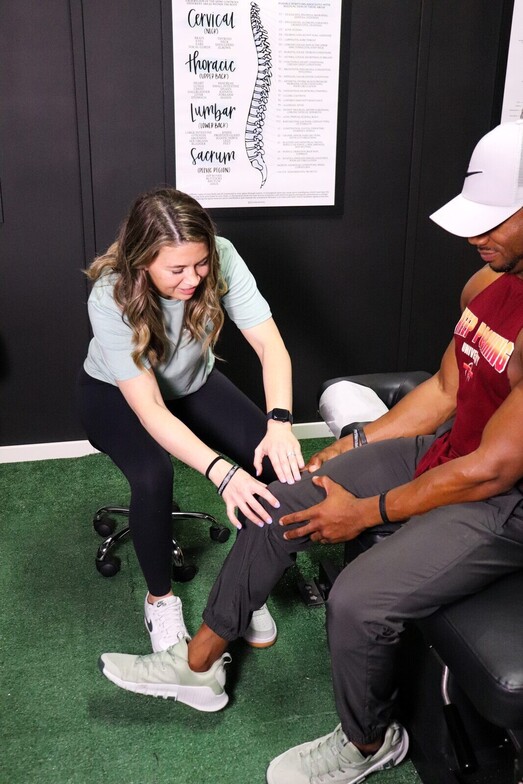
Myofascial release is a hands-on soft tissue technique. We place steady, targeted pressure on the restricted area and then guide your leg through specific movements. As the muscle lengthens under that pressure, the tissue layers start to move independently again.
For a groin strain, we work along the length of the adductors, from the inner knee up toward the pelvis, and we pay close attention to the junction where the muscle turns into tendon. That area tends to hold the most restriction after a strain. We also check the hip flexors, the lower abdominals, and the hamstrings, since these share load and fascia with the adductors.
Many patients notice easier side-to-side movement and less of that pulling sensation within the first few visits. Our goal is not just to loosen the tissue for a day, but to give you a window where you can load it well and actually build capacity.
What a Full Plan Looks Like
Soft tissue work is one piece of the picture. A typical plan with us includes:
- A thorough movement assessment to see how your hips, pelvis, and low back share the load.
- Myofascial release to restore glide and range through the adductors and nearby tissue.
- Progressive strengthening, often starting with isometric holds like the Copenhagen plank progression and building toward faster, sport-specific work.
- Chiropractic adjustments to the hips, pelvis, or low back when joint restrictions limit how the area moves.
- A clear return-to-play progression so you build back to sprinting and cutting in steps instead of guessing.
We tailor the pace to your sport and your schedule. A high school soccer player heading into a spring club season needs a different timeline than a weekend lifter.
When to Get It Checked
Book an evaluation if your groin pain keeps returning with the same movement, if you feel pain right at the pubic bone, or if the area still feels weak several weeks after the original strain. Pain that spreads into the low abdomen during coughing or sit-ups also deserves a closer look, since a few other conditions in that region can mimic a simple strain.
Get Back to Cutting and Sprinting With Confidence
If you live in Prosper or Aubrey and a nagging groin strain keeps pulling you out of practice, our team at Limitless Sports Chiropractic can help you get to the root of it. We work with athletes from Oak Point, Little Elm, Cross Roads, and Denton too, and we build every plan around the sport you want to get back to.
Book your visit with Dr. Taylor Hartman online and let's get that inner thigh moving the way it should.

Taylor Hartman
Contact Me