If you spend your day hunched over a desk, a steering wheel, or a barbell, you know the feeling: that deep, ropey tightness between your shoulder blades and across the top of your shoulders that never quite lets go. Stretching helps for about ten minutes. Then it's back. If that sounds familiar, you're not alone — it's one of the most common complaints I hear from patients across Oak Point, Little Elm, and the rest of North DFW, whether they're weekend athletes or just spend too many hours at a laptop.
Here's what's actually happening. The muscles across your upper back and shoulders — your traps, rhomboids, and the muscles around your shoulder blades — sit under constant low-grade tension from posture, repetitive overhead movement, or training load. Over time, the fascia (the connective tissue wrapping those muscles) starts to stick to the tissue underneath it instead of gliding freely. That restriction limits blood flow, keeps the muscle in a semi-contracted state, and is exactly why stretching alone doesn't fix it — you're pulling on tissue that's stuck, not tissue that's just short.
Why cupping works where stretching doesn't
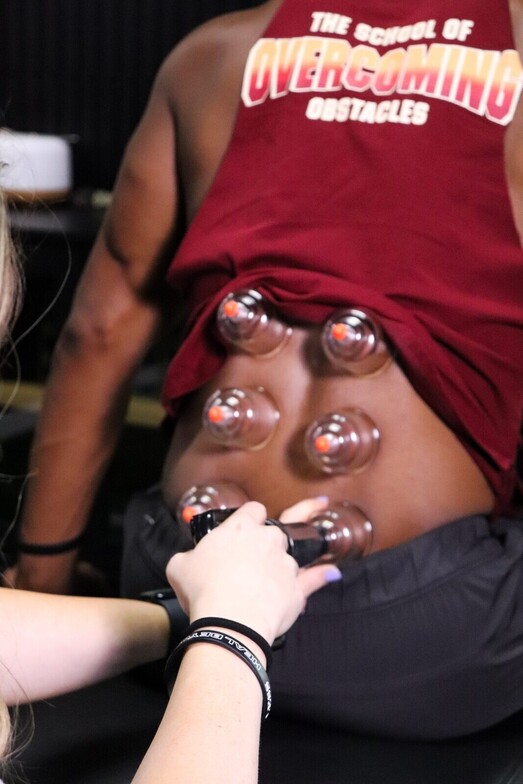
Cupping uses negative pressure — instead of pressing down into the tissue like a massage would, the cups lift the skin, fascia, and superficial muscle layer up and away from the structures underneath. That decompression does two things stretching can't: it pulls the stuck fascial layers apart so they can glide again, and it draws fresh blood into tissue that's been chronically restricted and under-nourished.
At Limitless Sports Chiropractic, we don't just set the cups and walk away. We add motion — you'll actively move your shoulder through its range while the cups are in place, whether that's shoulder rolls, arm reaches, or scapular retraction. Moving the joint while the tissue is decompressed helps retrain how that fascia glides during real, functional movement, not just while you're lying still. That's also why a session only takes about 5 to 10 minutes. It's not a 20-minute passive treatment — the motion component makes it far more efficient than static cupping.
It's not a separate appointment
One thing patients are often surprised by: cupping isn't something you book on its own. It's built into your follow-up chiropractic and soft tissue visits here. After we've adjusted your thoracic spine and shoulder mechanics, cupping is the soft-tissue piece that helps the surrounding muscles stop pulling everything back out of place. Adjustments restore joint motion; cupping addresses the fascia and muscle tension that got you stuck in the first place. Used together, they tend to hold longer than either one on its own.
Who this helps most
This approach tends to help three groups the most: athletes doing repetitive overhead work — swimmers, throwers, volleyball and baseball players — who develop chronic tightness across the upper traps and rear shoulder; desk-based professionals and students whose posture keeps the upper back locked in a rounded, tight position for hours at a time; and anyone recovering from a shoulder or upper-back injury who needs the surrounding fascia mobile again before full strength work can resume.
If you've tried foam rolling, massage, or just "toughing it out" and the tightness between your shoulder blades keeps coming back, it's worth having someone actually assess why the tissue is restricted in the first place rather than just treating the symptom again and again.
What to expect
During your visit, we'll assess your shoulder and thoracic spine mobility, perform any needed adjustments, and then apply cupping with active motion to the restricted areas — most commonly the upper traps, rhomboids, and rear shoulder capsule. You'll likely see some circular marks afterward from the increased blood flow; these aren't bruises and typically fade within a few days. Most patients notice looser movement and less pulling tightness within 24 to 48 hours.
If you're dealing with chronic shoulder or upper back tightness and you're looking for a sports chiropractor in Oak Point, TX or a chiropractor in Little Elm, TX who treats the actual cause instead of just the ache, we'd like to help. Limitless Sports Chiropractic works with athletes and active adults throughout Oak Point, Little Elm, Prosper, Aubrey, and the surrounding North DFW area to get tight, restricted tissue moving again — not just temporarily loosened.
Ready to stop living with that knot between your shoulder blades? Book your visit at Limitless Sports Chiropractic and let's get to the actual cause of the tightness.

Taylor Hartman
Contact Me