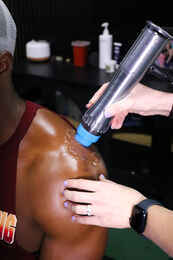
If you've had a deep, nagging ache in the front or side of your shoulder for more than a few weeks — the kind that flares when you reach overhead, sleep on that side, or load the shoulder during a lift or a throw — there's a good chance you're dealing with rotator cuff tendinopathy, not just “tight shoulders.” I see this constantly in athletes and active adults who come through my clinic in Oak Point, and it's one of the most frustrating injuries to sit with because rest alone rarely fixes it.
Why Rest Doesn't Solve Rotator Cuff Tendinopathy
Tendinopathy isn't inflammation in the classic sense. It's a breakdown in the structure of the tendon itself — the collagen fibers that make up your rotator cuff tendons (usually the supraspinatus) become disorganized and degenerated from repetitive overload without adequate recovery. That's why anti-inflammatories and a few days off the gym often help for a moment and then the pain creeps right back. The tendon tissue hasn't actually healed; it's just been given a temporary break from the load that irritates it.
Left untreated, chronic rotator cuff tendinopathy tends to go one of two ways: it either becomes a persistent, low-grade limitation that quietly caps how much overhead work you can do, or it progresses toward a partial tear. Neither outcome is one you want to wait out.
How Shockwave Therapy Targets the Tendon Itself
Shockwave therapy (extracorporeal shockwave therapy, or ESWT) uses focused acoustic pressure waves delivered through the skin directly into the degenerated tendon tissue. Instead of just managing symptoms, it works on the underlying problem in a few specific ways:
It triggers a controlled micro-inflammatory response in tissue that has stalled out in a degenerative, non-healing state — essentially restarting the biological healing process the body wasn't completing on its own. It stimulates new blood vessel formation (neovascularization) in the tendon, which matters because chronically degenerated tendons are often poorly vascularized, starving them of the nutrients they need to remodel. And it helps break down calcific deposits that frequently build up in long-standing rotator cuff tendinopathy, which can be a major contributor to pain and restricted motion.
For patients, this usually means noticeable improvement over a series of sessions rather than one dramatic fix — most people see meaningful change over 3 to 6 treatments spaced about a week apart, paired with a loading program to rebuild the tendon's capacity once it starts responding.
What a Session Actually Feels Like
Shockwave treatment for the shoulder takes about 5 to 10 minutes of active treatment time. The sensation is a rapid, percussive pulsing over the tendon — most patients describe it as uncomfortable but tolerable rather than sharp or unbearable, and we adjust intensity based on your tolerance. It's normal to feel some soreness for a day or two afterward, similar to how a deep tissue treatment might feel, before the benefits start to show up over the following days.
Why This Isn't the Same as Graston or Scraping
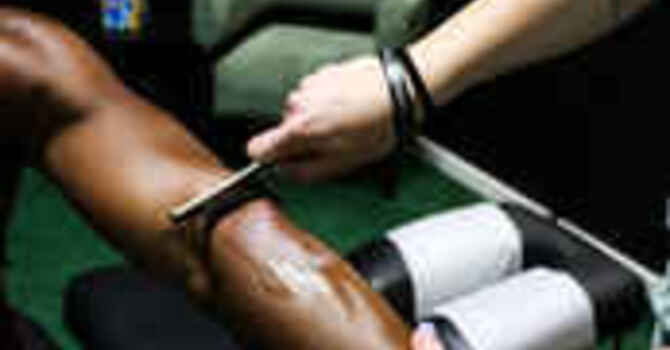
It's worth being clear about the distinction here, because I get this question a lot: this is different from manual scar-tissue work like Graston Technique, which addresses mobility restrictions and adhesions with an instrument against the skin. Shockwave therapy is aimed specifically at stimulating a biological healing response inside degenerated tendon fibers — it's a regenerative approach to the tendon itself, not a mobility or scar-tissue release technique. For a lot of patients with rotator cuff tendinopathy, the two approaches actually work well as complements once the tendon starts responding.
Who This Helps Most
This is especially relevant for throwing athletes, swimmers, weightlifters, and anyone whose sport or job involves repeated overhead motion — but I also see it in people who simply slept wrong for a few weeks or ramped up a home workout routine too fast. If overhead reaching, sleeping on that shoulder, or pressing movements have been bothering you for more than three or four weeks, it's worth getting evaluated rather than waiting to see if it resolves on its own.
Get Your Shoulder Evaluated
If shoulder pain has been limiting your training, your work, or just your sleep, don't assume it'll work itself out. As a sports chiropractor in Oak Point, TX, I work with patients from across the North Dallas–Fort Worth area — including Little Elm, Aubrey, Crossroads, and Denton, TX — to properly diagnose rotator cuff issues and build a treatment plan that actually addresses the tendon, not just the symptoms. Reach out to Limitless Sports Chiropractic to schedule an evaluation and find out whether shockwave therapy is the right next step for your shoulder.

Taylor Hartman
Contact Me